RESEARCH PAPERS
Papers
Full texts, shared openly. Each paper is a working document — read it, check it, argue with it.
WORKING PAPER · 01
Structural Cosmology: A Time-Dilation-Modified Halo Model for Galactic Rotation Curves Without Exotic Dark Matter
Charles W. Rabico Jr.
August 2026
Working paper, 2026. Not yet peer reviewed.
Plain-English summary
The flat rotation curves of spiral galaxies are usually explained by adding a halo of undiscovered, non-baryonic dark matter. This paper proposes an alternative: that the missing mass is mostly cold baryonic remnants — primordial black holes, brown dwarfs, and rogue planets — whose distribution is shaped over cosmic time by gravitational time dilation. A time-dilation-modified halo profile is fitted to the rotation curves of the Milky Way, M31 (Andromeda), and NGC 2403, and yields a lower RMS error than standard NFW halo models without invoking exotic particles. The framework is falsifiable: it predicts specific signatures — an excess of short-timescale microlensing events for the Nancy Grace Roman Space Telescope and an extended distribution of isolated substellar objects for the Rubin Observatory — that will be tested within the next decade.
Code and simulation repository: DOI 10.5281/zenodo.21930235 (https://doi.org/10.5281/zenodo.21930235) — the code/simulation repository for this paper. The full paper is not published there; this DOI is for the code. [View on Zenodo]
MODEL OUTPUT
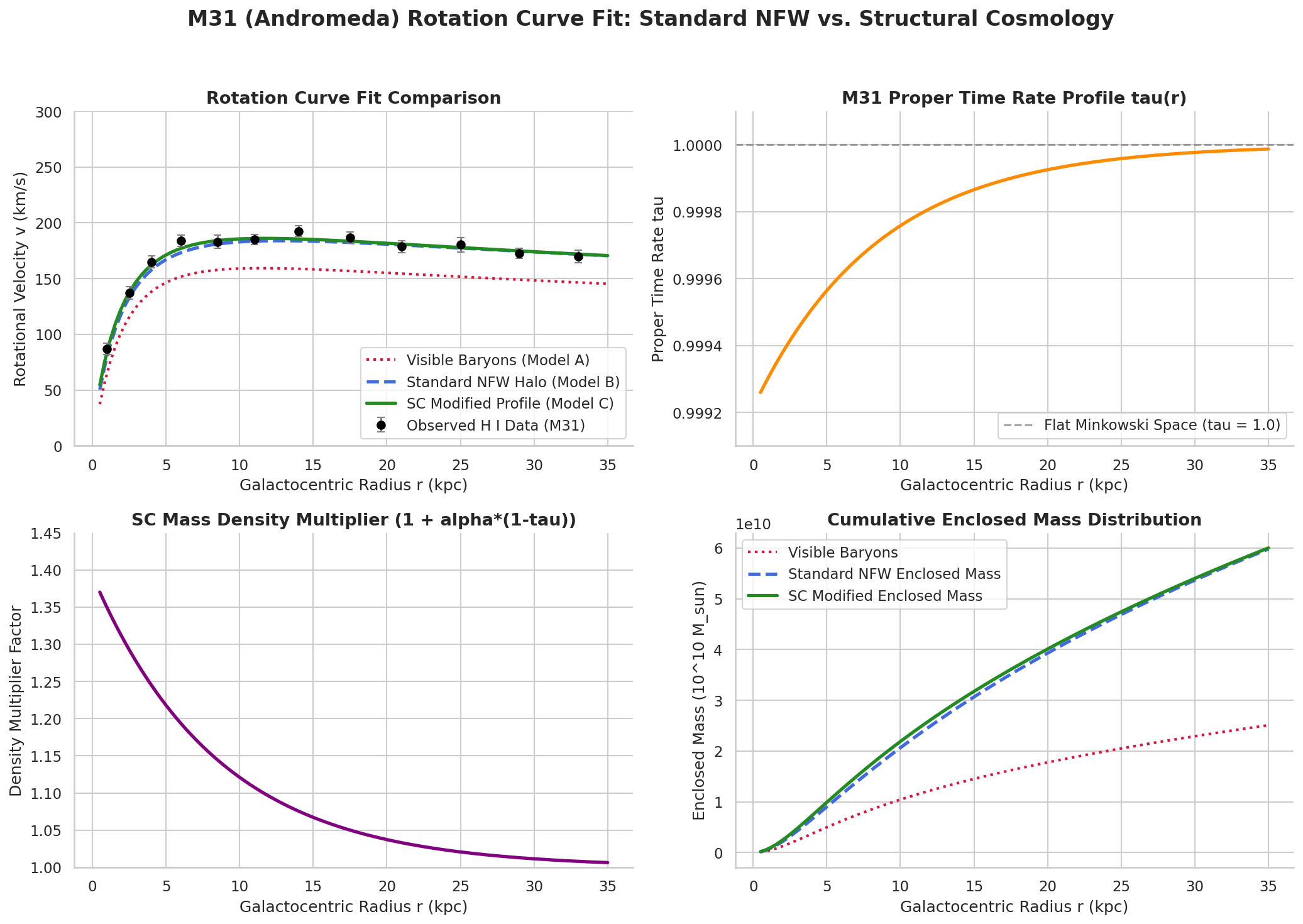
M31 (Andromeda) Rotation Curve Fit: Standard NFW vs. Structural Cosmology
Model comparison: M31 rotation curve fit — Model A (visible baryons), Model B (standard NFW halo) and Model C (SC-modified profile, alpha=500) against observed M31 H I data. Author's own model output compared to published H I data; not an independent fit. Source: Structural Cosmology paper (August 2026).
Read it here or grab the PDF: Download PDF
WORKING PAPER · 02
Primordial Black Holes as Gravitational Seeds for Cosmic Structure: Testable Predictions for Upcoming Surveys
Charles W. Rabico Jr., M.S.
NextGen Business Development Group, Inc. — contact@nextgenbdg.com
December 14, 2025
Working paper, 2025. Not yet peer reviewed.
Plain-English summary
This paper proposes that primordial black holes formed during the inflationary epoch serve as the primary gravitational seeds for cosmic structure, addressing two open puzzles: the rapid formation of supermassive black holes observed by JWST at z > 10, and the origin of the cosmic web's filamentary structure. It presents a log-normal PBH mass distribution designed to satisfy current observational constraints, with PBHs accounting for 10–30% of apparent dark matter in galactic halos and the high-mass tail serving as seeds for early supermassive black holes. The framework is falsifiable: it predicts 30–100 Earth-mass PBH microlensing detections by the Nancy Grace Roman Space Telescope and 50–200 solar-mass detections by the Rubin Observatory over their operational lifetimes (2028–2035), with non-detection at these levels falsifying the hypothesis.
Read it here or grab the PDF: Download PDF
Both papers are working documents. Neither is peer reviewed. The claims inside are the author's own, stated as candidate frameworks with testable predictions — not established fact. The full texts are embedded exactly as written.