The Sovereign Engine — People-First Business Engine
The operating framework behind People-First Capitalism: build systems that increase the market value of the people inside them.
The UnfilteredOPEN NOTEBOOK · 18 MONTHS AND COUNTING
Working documents, drafts, code and dated predictions — shared as they were made, not as they were cleaned up. Judge the work, not the résumé.
Everything here is timestamped. Where something is unfinished, it says so.
START HERE — THE FRAMEWORKS
Before the cosmology, the part that runs companies.
The operating framework behind People-First Capitalism: build systems that increase the market value of the people inside them.
How humans actually update their models in real time — and why most institutions reward memorization instead.
A people-first framework for mentorship and reintegration inside legacy institutions — treating people as builders, not cases.
THE LAB — CLEARLY LABELLED
The physics work. Shared as an open notebook with the falsification criteria attached, because a claim that cannot lose is not a claim.
Nothing on this page claims proof. These are working drafts, reported candidates and predictions awaiting test — publishable precisely because they can be wrong.
FIGURES
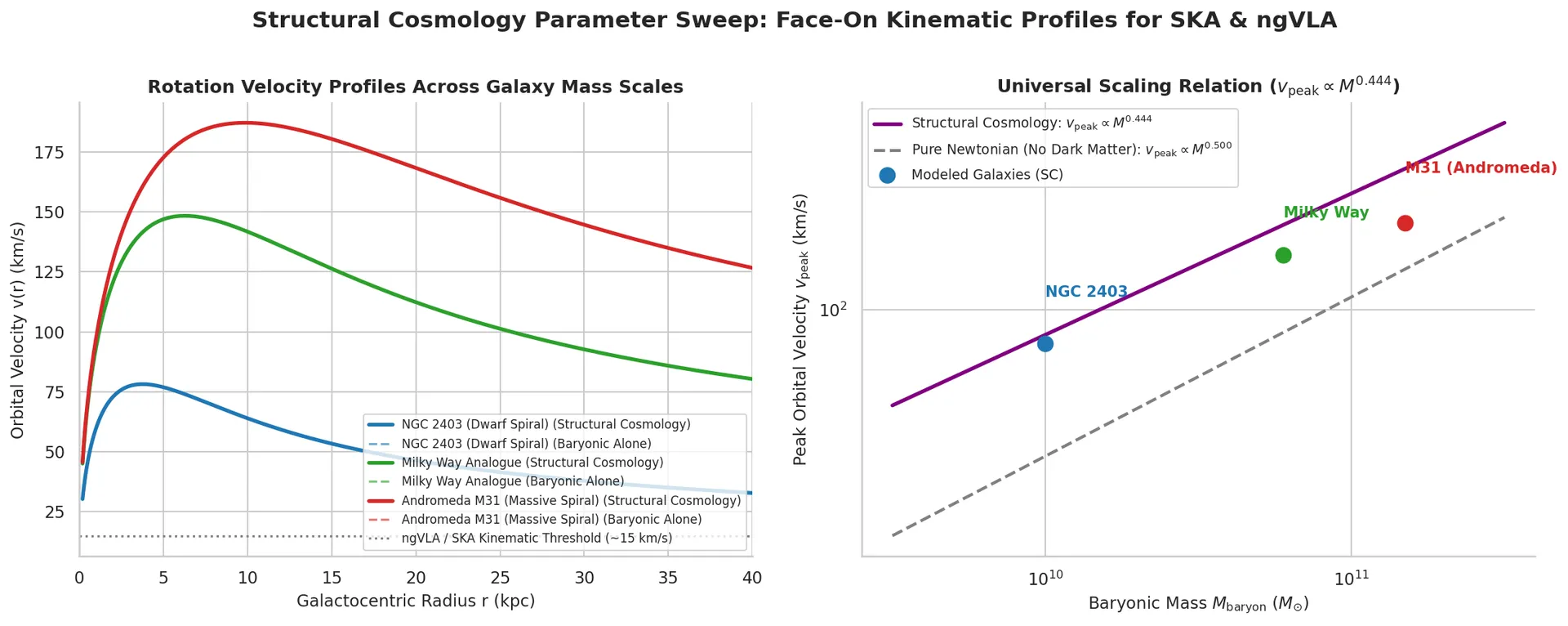
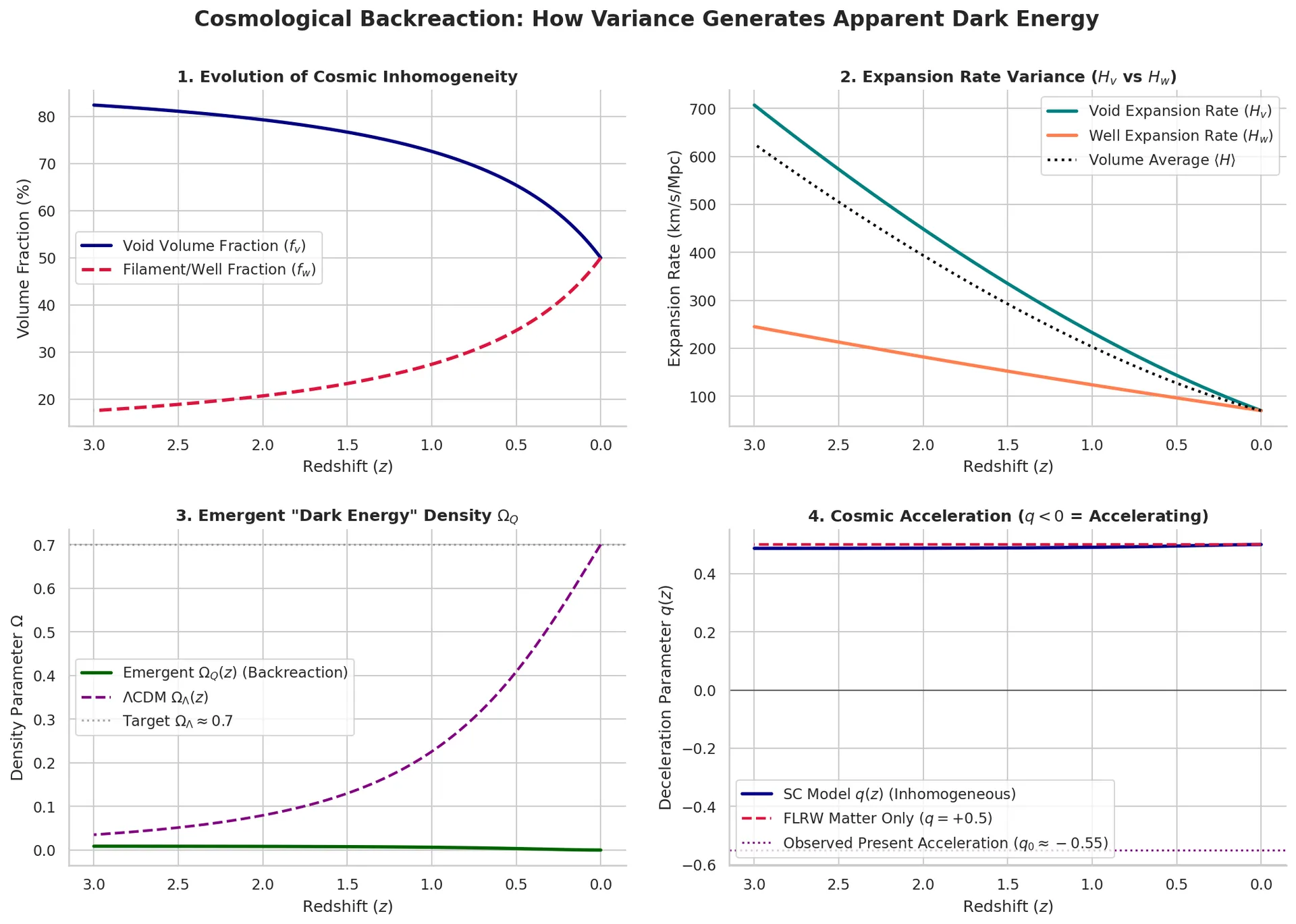
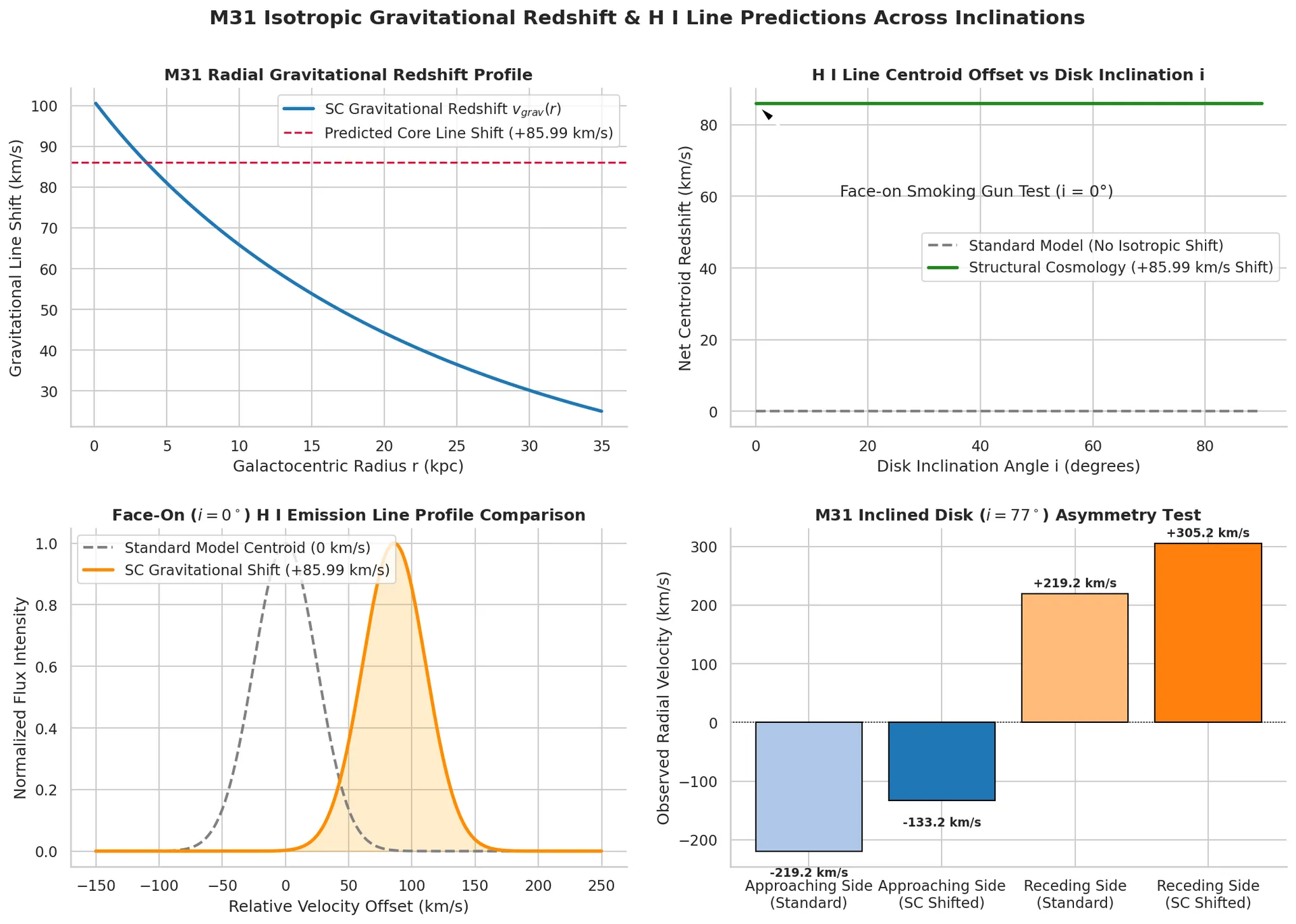
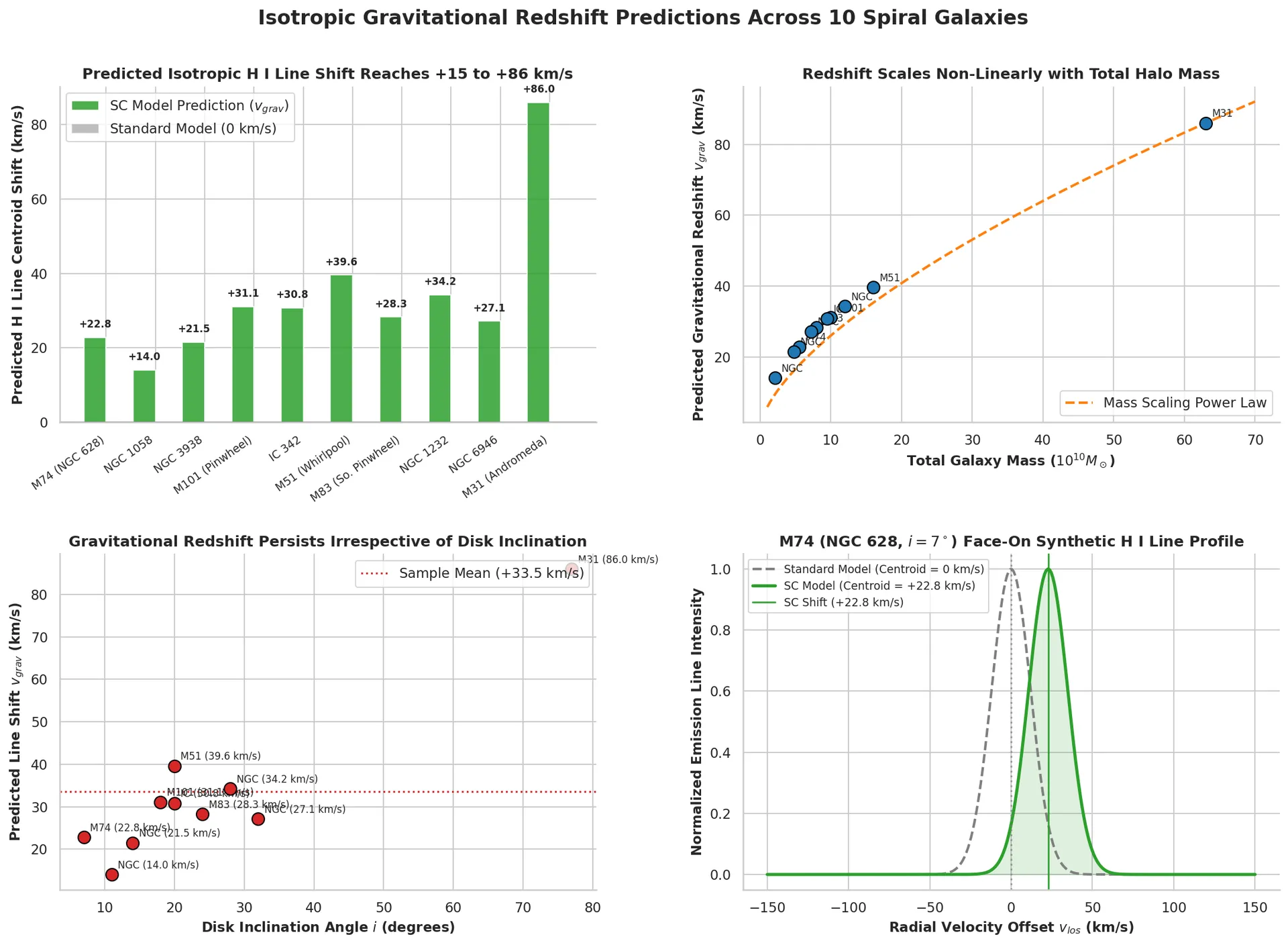
These are outputs of the author's own model, not published observations. They show what the framework predicts — not what has been measured.
Disclosure: the accumulation parameter alpha = 500 was tuned phenomenologically; no AIC/BIC comparison is reported. These are the author's own model outputs, not an independent fit.


WORKING FRAMING
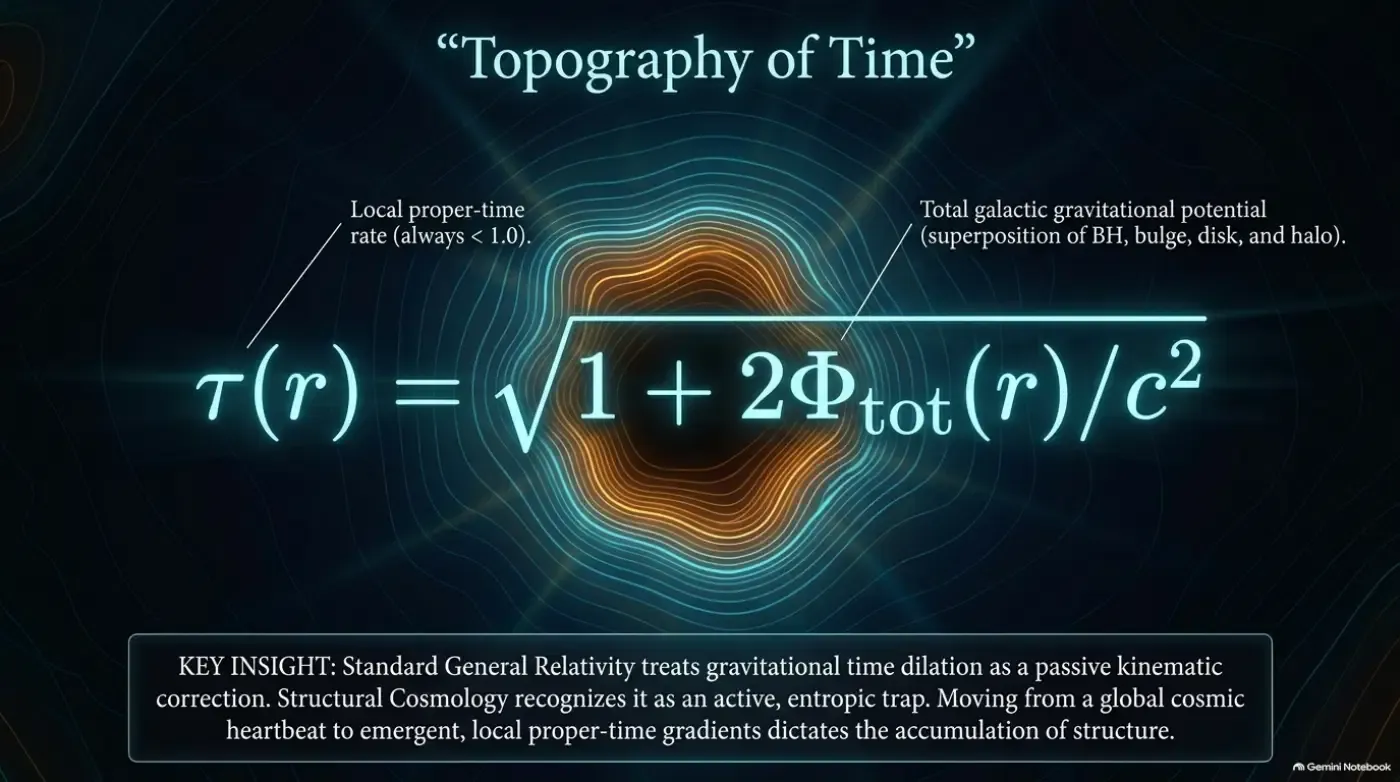
The core relation of the framework: the local proper-time rate as a function of the total galactic potential (black hole, bulge, disk and halo combined). Working theoretical framing used across the lab's models — a candidate model pending testing.

MODEL OUTPUT
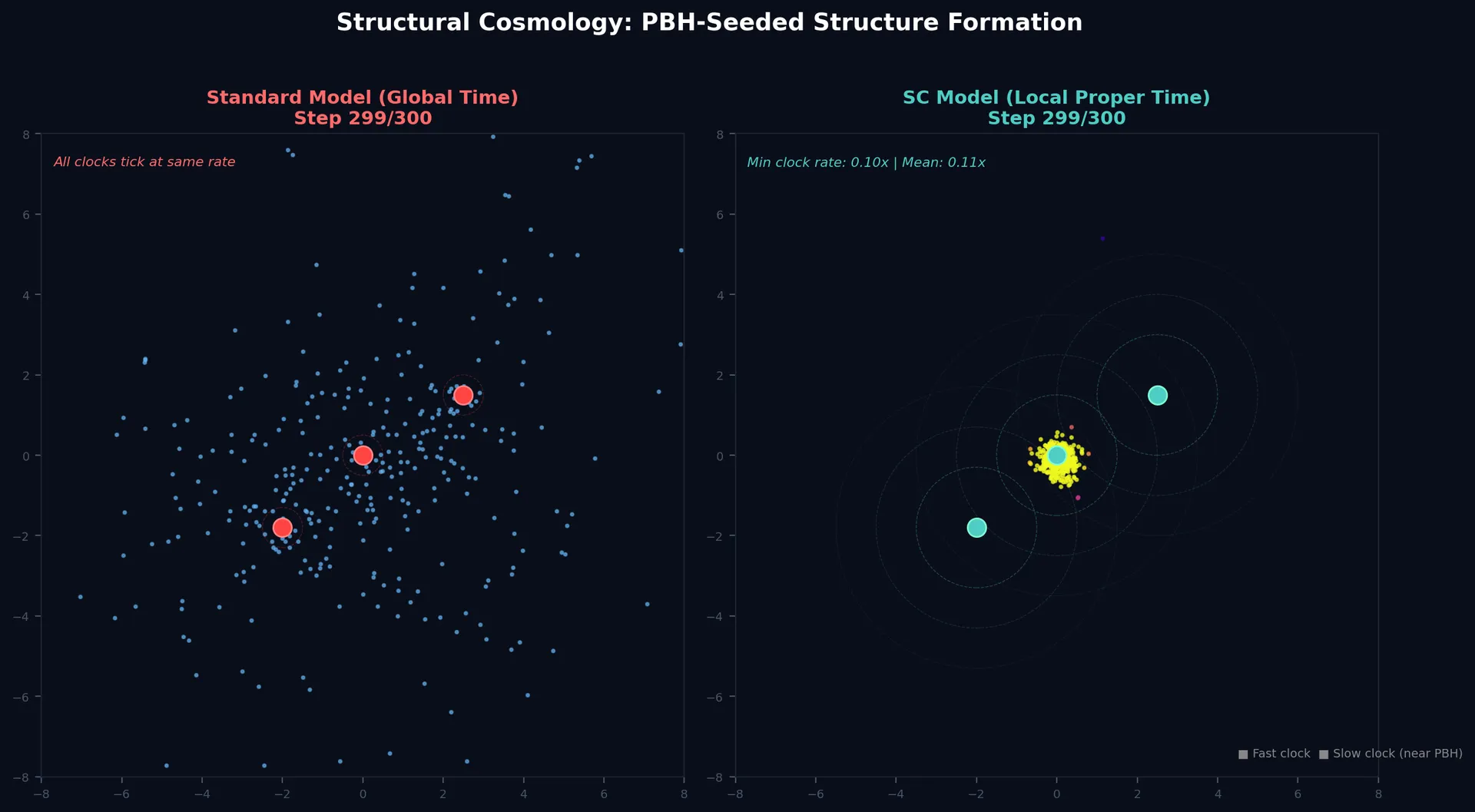
Side-by-side simulation at step 299/300: Standard Model global time (left) versus Structural Cosmology local proper time (right). Illustrative model output from a working simulation, not an observation.

WORKING FRAMING
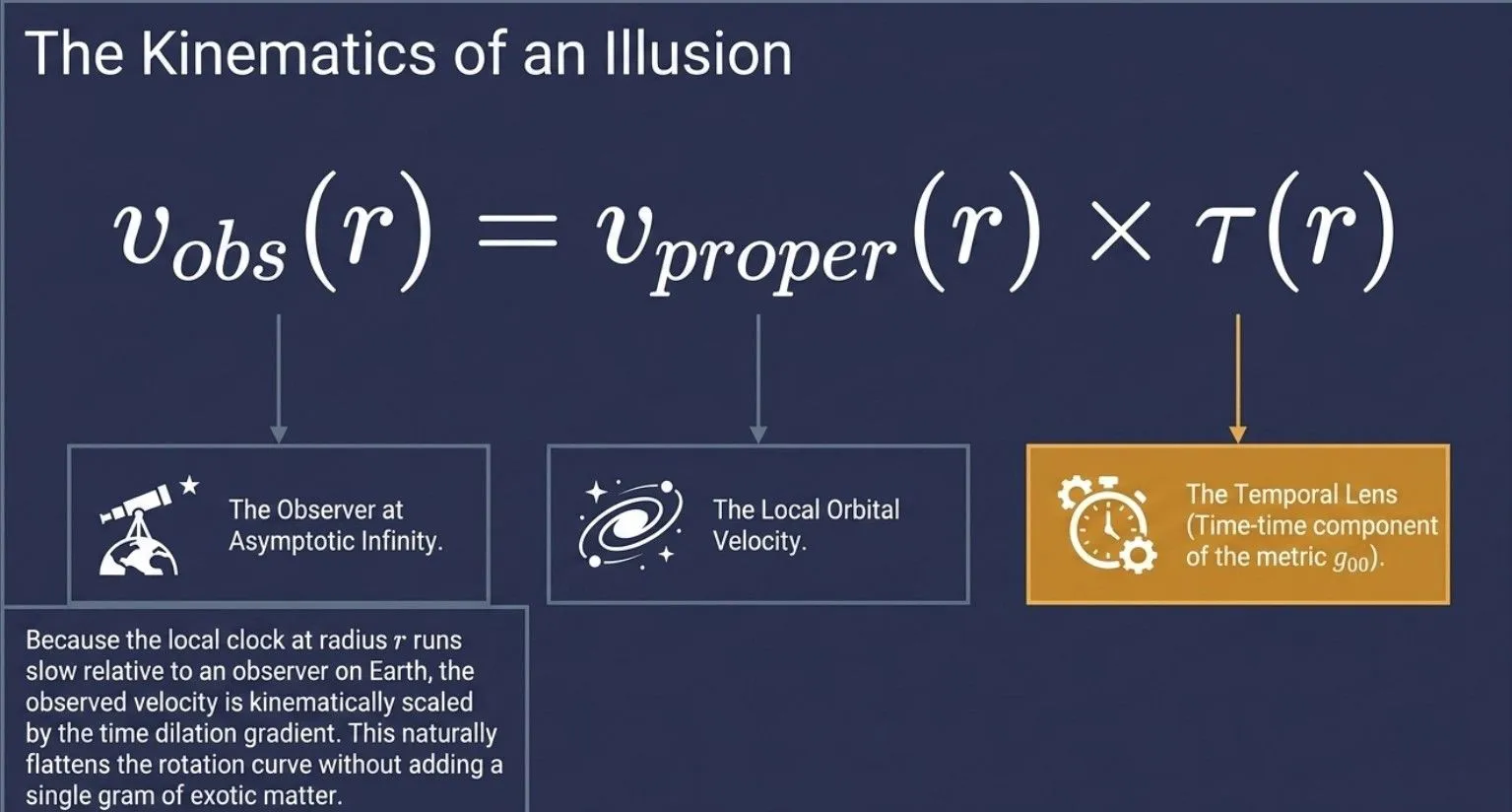
The temporal-lens relation, v_obs(r) = v_proper(r) × tau(r): observed velocity as local orbital velocity scaled by the time-dilation gradient. Working theoretical framing, a candidate model pending testing — not a confirmed result.

WORKING FRAMING
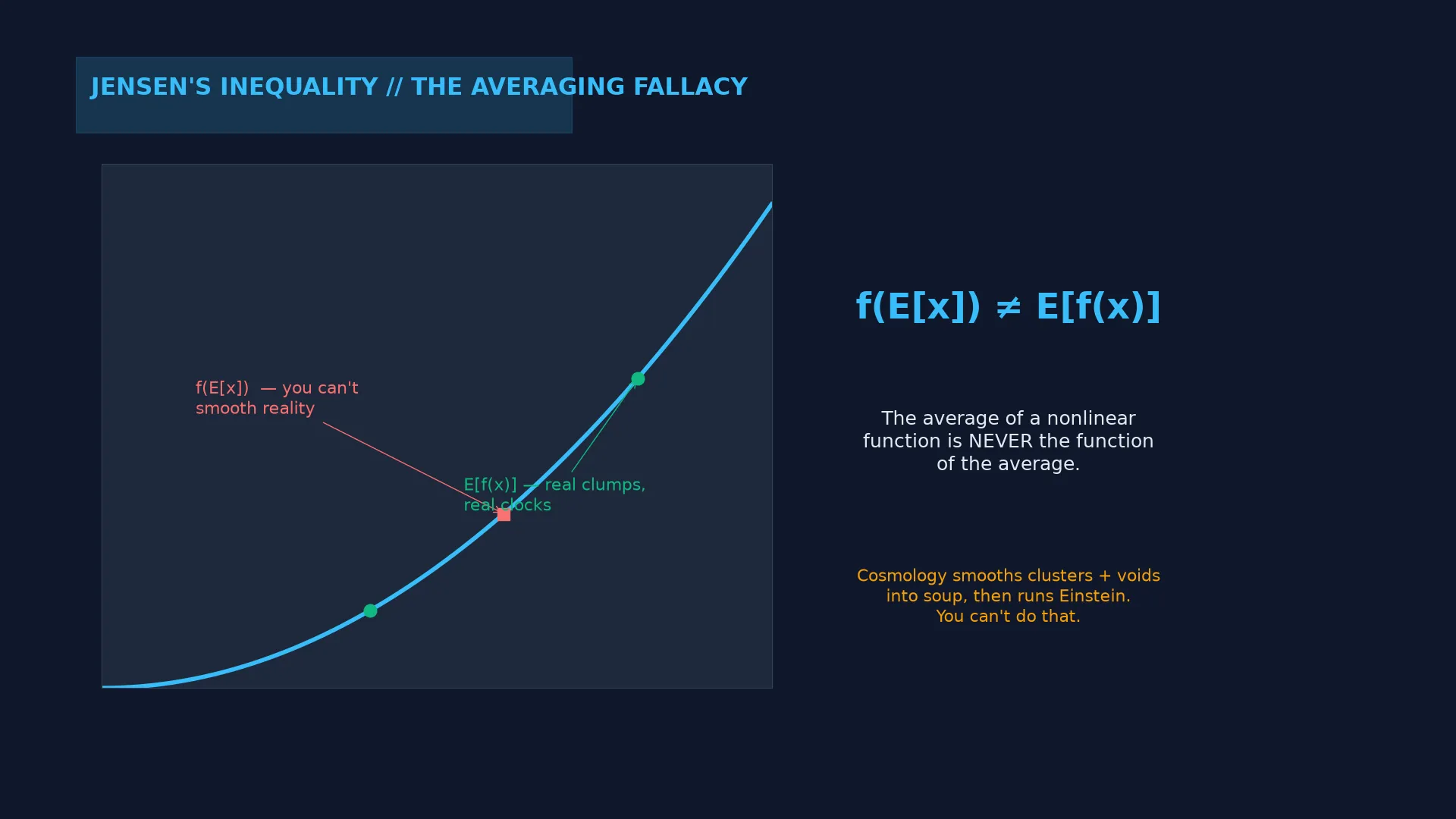
f(E[x]) is not equal to E[f(x)]. The average of a nonlinear function is never the function of the average — the argument against smoothing clusters and voids before applying the field equations. Working theoretical framing.
PREPRINT · IN REVIEW
The Structural Cosmology preprint is under review — awaiting a Zenodo community reviewer. The work currently lives in the open repository.
Reference implementation of the SC equations: rotation curves for the Milky Way, M31 and NGC 2403, plus PBH-seeded N-body structure formation.
The full write-up, including the honest reproducibility note: the comparison data are normalized to unity for shape comparison, and the code is a methodological reference rather than a byte-for-byte reproduction.
The N-body PBH-seeded structure formation simulations, released as a citable record.
Predictions for the Nancy Grace Roman Space Telescope and the Vera C. Rubin Observatory / LSST, plus the RMS-residual results table.
The public index for the working repository.
The tagged reference implementation release.
The four scripts behind the results.
Identified after the draft was assembled. For face-on disk galaxies the SC time-dilation mechanism predicts a positive, mass-dependent HI 21cm centroid shift scaling as v_peak ~ M^0.444 (from roughly +15 km/s for dwarfs to +86 km/s at Milky-Way mass). Falsification criterion: if SKA / ngVLA face-on surveys return a flat, mass-independent line at zero within measurement precision, the model is wrong as stated. That outcome is welcomed, not defended.
The SC-modified halo profile applied to the Milky Way, M31 and NGC 2403 — reporting a 1.8%–4.6% reduction in RMS error versus standard NFW: Milky Way 3.94%, M31/Andromeda 4.64%, NGC 2403 1.82%. Includes the Roman and Rubin observational discriminators and a full reference list.
Disclosure: the accumulation parameter alpha = 500 was tuned phenomenologically; no AIC/BIC comparison is reported. These are the author's own model outputs, not an independent fit.
A proposal to map galactic halos with the Nancy Grace Roman Space Telescope and the Vera C. Rubin Observatory / LSST.
Prediction: 50–150 short-timescale (tE < 1 day) microlensing events per year, versus the 10–20 expected from standard stellar models.
The M^0.444 mass-dependent scaling relation for face-on spiral galaxies, with the target benchmark table for next-generation radio interferometers.
v_peak ≈ 11.95 × (M_tot / 10^10 M_sun)^0.444 km/s
| Target Galaxy | Total Mass (10^10 M_sun) | Disk Scale Rd (kpc) | Core Dilation (1 − τ_core) | Face-on Redshift Peak v_peak (km/s) |
|---|---|---|---|---|
| Ultra-Dwarf (Pegasus) | 1.0 | 1.56 | 1.20 × 10^-4 | 11.95 km/s |
| NGC 2403 (THINGS) | 10.0 | 2.05 | 2.31 × 10^-4 | 35.24 km/s |
| Milky Way (Eilers) | 38.0 | 3.59 | 5.35 × 10^-4 | 74.91 km/s |
| Andromeda (M31) | 63.0 | 4.97 | 7.85 × 10^-4 | 85.99 km/s |
| UGC 2885 (Rubin's) | 150.0 | 9.75 | 11.53 × 10^-4 | 118.42 km/s |
| Giant Ellipticals | 300.0 | 18.00 | 14.12 × 10^-4 | 148.51 km/s |
Observatory context: these figures are model predictions to be tested, not measured results.
Quantitative microlensing detection-rate predictions for the Roman Space Telescope and Rubin Observatory, with the expected rates under a 1%, 10% and 30% PBH dark-matter fraction, and the mass-range sensitivities of Roman, Rubin and Euclid.
The first short note of the argument, written before the model: a relativistic correction to how rotation curves are interpreted, with the time-dilation gradient across a galaxy as the proposed mechanism. Kept as a dated early draft, not a result.
The original manuscript of the framework: time as a cognitive compression artifact, galaxies as persistent structures, and the entropic reading of voids and dark energy. Superseded by later drafts; retained on purpose as the trail.
DATED PREDICTIONS · NOT RESULTS
Predictions to be tested. These are not reported results.
PREDICTION · NOT RESULTS
Nancy Grace Roman Space Telescope — 2028–2033 · elevated rate of short-timescale gravitational microlensing events in the Galactic bulge.
PREDICTION · NOT RESULTS
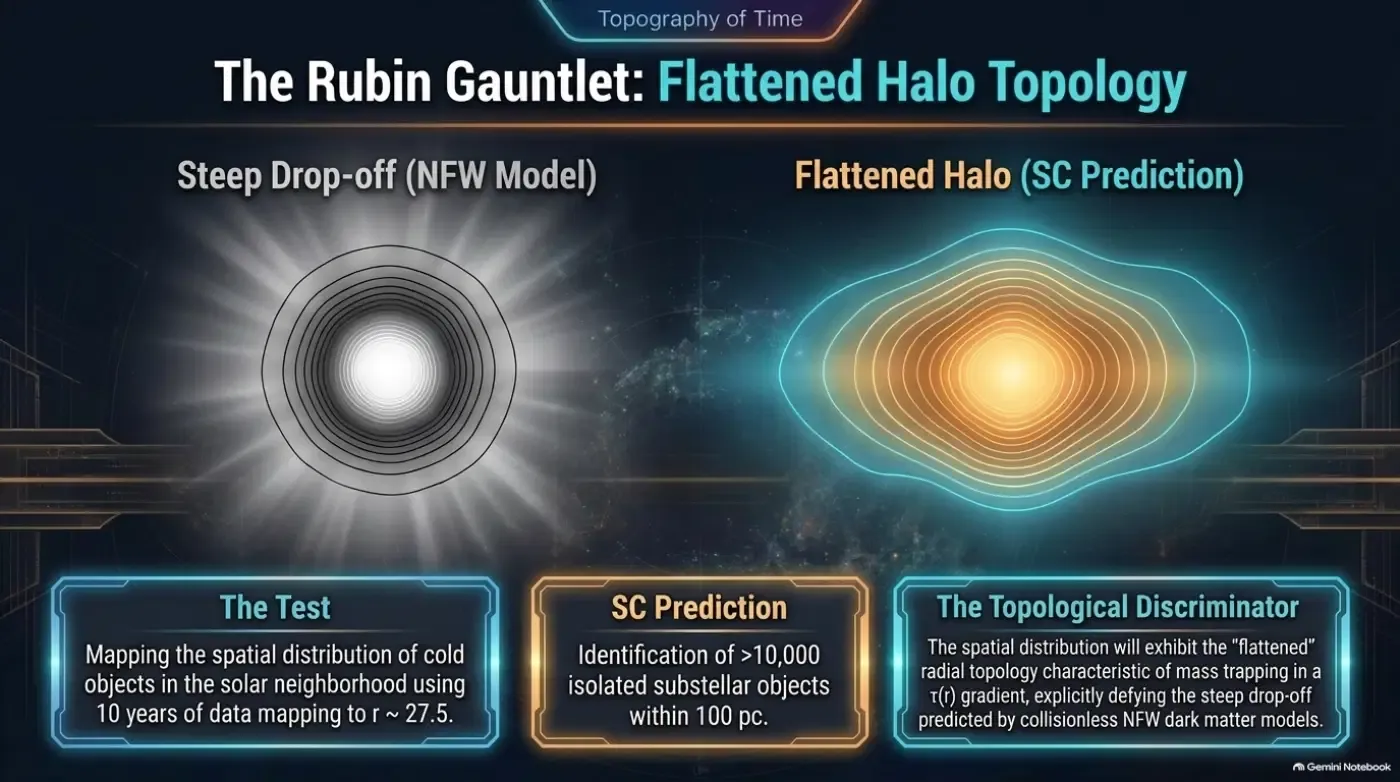
Vera C. Rubin Observatory / LSST · >10,000 isolated sub-stellar objects within 100 pc, with a distribution defying standard NFW models.

ROADMAP
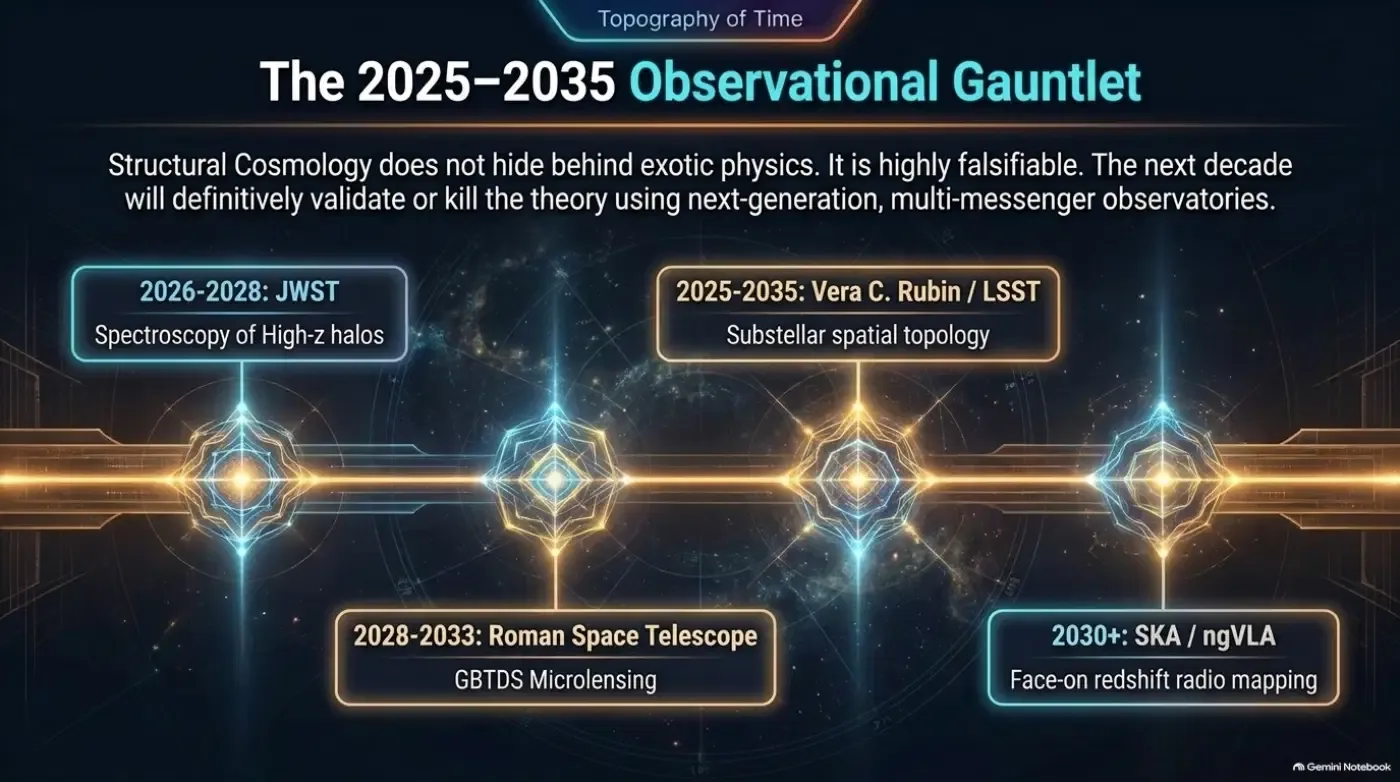
The predicted test windows the framework will be judged against: JWST high-redshift halo spectroscopy (2026–2028), Roman GBTDS microlensing (2028–2033), Vera C. Rubin / LSST substellar topology (2025–2035), and SKA / ngVLA face-on mapping (2030+). Predictions awaiting testing, not results.

PREDICTION
The predicted "flattened" radial halo topology set against the steep drop-off of collisionless NFW models — a topological discriminator to be tested against forthcoming substellar surveys. Prediction awaiting testing.
WORKING DOCUMENTS · AVAILABLE ON REQUEST
The mathematical walkthrough behind the model.
The December 2025 PBH seeding paper: a log-normal mass distribution with peak at Earth mass, PBHs proposed as 10–30% of apparent dark matter, and microlensing predictions for Roman and LSST. Includes its own explicit falsification conditions.
THE ARGUMENT, IN PROSE
The arguments that sit beside the code, still open to scrutiny.
Local clocks and the history of the universe: the naked-black-hole question, gravity as a temporal trap, and baryonic remnants as the missing mass.
An essay version of the argument, written from the author's behavioural-science background: context dictates behaviour, and temporal context may dictate the behaviour of matter.
Framing note: the 'Phoebe' microlensing event cited in this essay was reported in 2026 and has since been withdrawn — Udalski & Mroz (arXiv:2606.19442) re-analysed the same data and identified the source as an ordinary variable star. The Barontini experiment is a controlled tabletop test of relational time, reported in the literature; it is not treated as confirmation of this framework. The 2025 prediction remains untested, not falsified.
The Roman Space Telescope and Rubin Observatory references at the end are predictions awaiting test, not verdicts.
Read the essay (.docx)Six short lessons on time, space and human sovereignty — the argument in its most direct form.
Structural Cosmology Research · Charles W. Rabico Jr. · Phoenix, AZ — shared as an open notebook. Timestamps are real; unfinished work says so.